

Ayurveda for Psoriasis — How Panchakarma Treats Skin From Inside?
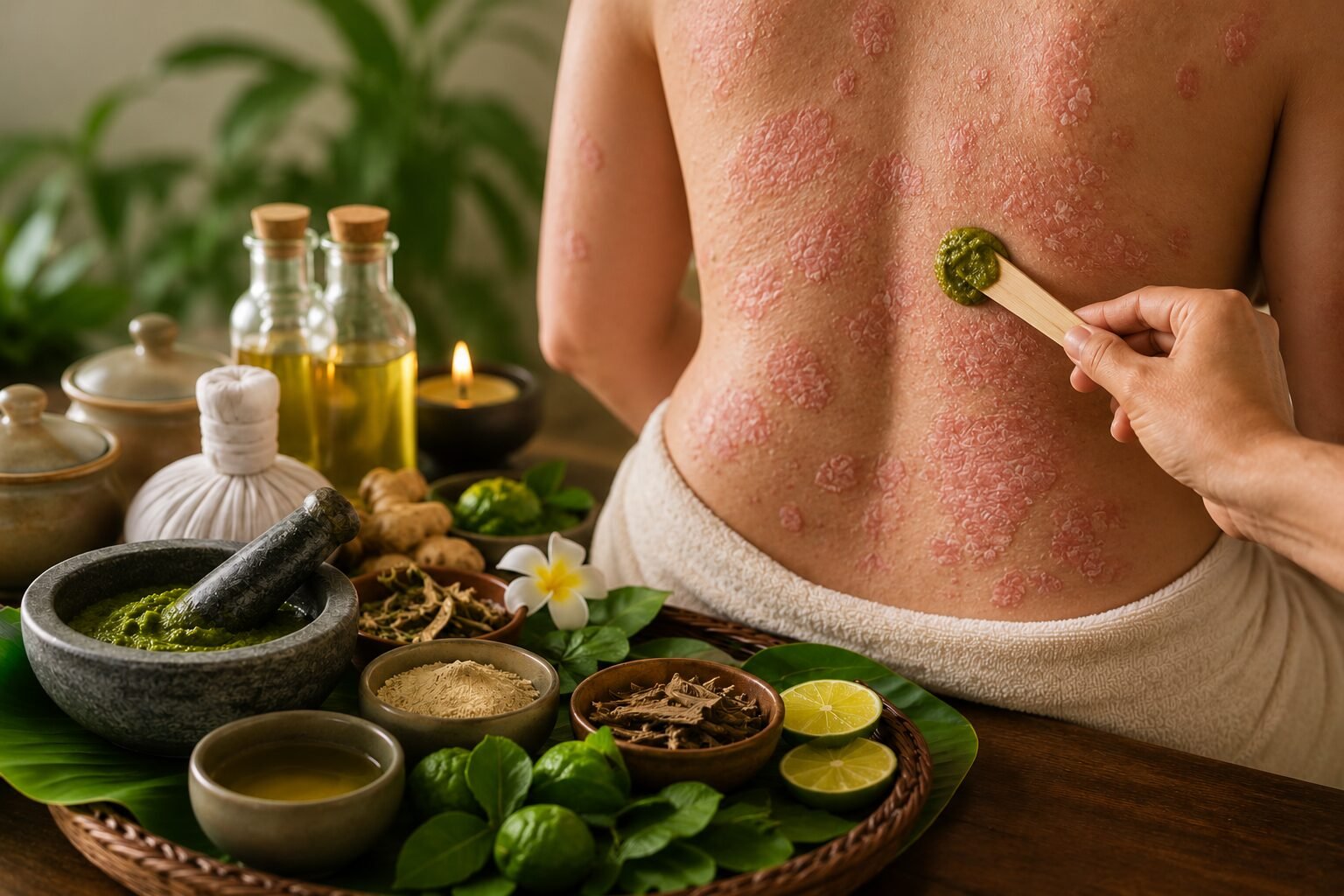
Psoriasis keeps coming back. Steroids clear the plaques for a few weeks. Stop the cream and the scales return, often thicker. Ayurveda calls this Kitibha Kushtha a systemic metabolic failure that shows itself on the skin. The plaques are not the disease. They are what happens when the gut and liver cannot process accumulated Ama and the body pushes it outward. Treating the surface without clearing that internal load is why psoriasis never fully stops.
According to I-AIM Healthcare Centre, Ayurveda Hospital in Bangalore, “Psoriasis is rooted in impaired Agni and Ama across multiple tissue layers. Clearing the skin without clearing those layers first is why most treatments only last as long as you keep applying them.”
Plaques returning every season despite years of treatment? Book Appointment
Why does psoriasis keep returning with conventional treatment?
Modern treatment suppresses the immune overreaction. It does not correct what triggered the immune system to misfire in the first place.
- Ama is still sitting in the tissues: Psoriasis in Ayurveda is a Bahudoshavastha condition, meaning multiple doshas are vitiated simultaneously and toxins have penetrated deep tissue layers (Dhatus). Topical treatment never reaches that depth. The toxin load stays, the trigger stays, the plaques return
- Agni remains weak: The original metabolic dysfunction that allowed Ama to accumulate is never corrected. Every meal produces more Ama. The body keeps trying to push it outward through the skin because the gut cannot process it efficiently
- Vata-Kapha combination is stubborn: Kitibha Kushtha specifically involves Vata dryness driving skin thickening and Kapha producing the silvery scale. This combination requires internal oleation and purification therapies, not topical corticosteroids that only suppress the Pitta inflammatory layer temporarily
- Stress loads the trigger: Emotional stress directly aggravates Vata and Pitta simultaneously in psoriasis patients. No prescription addresses the neuro-endocrine pathway that converts psychological stress into a skin flare. Ayurvedic treatment works on this connection through internal medicines and Panchakarma procedures that calm the nervous system alongside detoxification
The Panchakarma protocol at I-AIM sequences procedures specifically to address Bahudoshavastha, clearing Ama layer by layer before the skin can genuinely heal.
How does Panchakarma actually treat psoriasis internally?
The approach depends on severity and which doshas are most vitiated. A standard psoriasis protocol runs 21 to 28 days and moves through three phases.
- Snehapana first: Internal administration of medicated ghee in increasing doses for 5 to 7 days. The ghee enters deep tissue layers and loosens the Ama that has lodged there over years. Patients notice their plaques soften and sometimes expand slightly before they begin to clear. That is the toxin mobilising, not the condition worsening
- Virechana as the primary purge: Medicated purgation on the appropriate day removes the mobilised Pitta and Ama through the bowel. For most psoriasis patients, Virechana is the most critical single procedure in the protocol. Patients who have completed it report the longest remission periods, often 12 to 18 months without a flare
- Takradhara for the nervous system component: Medicated buttermilk poured over the forehead and scalp for cases with significant stress-driven flares or scalp psoriasis. Cools Pitta, calms Vata aggravation, and addresses the emotional trigger mechanism alongside the metabolic one
- Internal medicines through the course: Arogyavardhini Vati, Gandhaka Rasayana, Khadirarishta, and Manjistha-based formulations prescribed throughout. These work on liver function, blood purification, and Agni restoration simultaneously. The skin cannot clear if the liver is not processing waste efficiently
Read about Panchakarma benefits for a broader picture of how the detoxification protocols work across different conditions.
Why Choose I-AIM Healthcare Centre
I-AIM is NABH-accredited with a dedicated Panchakarma department and over 14 years of integrative Ayurvedic practice in Bangalore. Psoriasis cases here are assessed with both Nadi Pariksha and modern diagnostics before treatment is prescribed. The protocol is built around the individual dosha pattern, not a standard psoriasis template.
A patient who had been on Methotrexate for three years came in during a severe flare covering both arms and lower back. Completed a 21-day inpatient Panchakarma course. At the 3-month follow-up, 80 percent clearance was documented. At 6 months, the patient had not used any topical steroid since discharge. That is what internal treatment looks like when the Ama has actually been removed.
Frequently Asked Questions
Can Ayurveda permanently cure psoriasis?
Ayurveda does not use the word cure for chronic Kushtha. What Panchakarma achieves is deep Ama clearance and Agni restoration, which produces long remission periods and significantly reduced flare frequency. Sustained results require dietary and lifestyle adherence after treatment.
How long does Ayurvedic treatment for psoriasis take?
A standard Panchakarma course for psoriasis runs 21 to 28 days inpatient. Moderate cases may see significant clearance within this window. Severe or long-standing cases may need a second course after a 3-month gap.
Is Panchakarma safe during an active psoriasis flare?
The physician assesses severity before deciding. Active flares with extensive Pitta aggravation may require initial internal medicines to stabilise the condition before Snehapana is started. Jumping into purgation during acute flare without preparation can aggravate the condition.
Does diet matter after Panchakarma for psoriasis?
Significantly. Nightshades, sour foods, fermented foods, red meat, and alcohol all aggravate Pitta and Kapha and can restart the Ama accumulation cycle. Post-treatment dietary discipline is what determines whether remission lasts 6 months or 6 years.
References
- Ayurvedic management of Psoriasis — NCBI / PubMed
- WHO Traditional Medicine Strategy — World Health Organization