

Basti Karma for Rheumatoid Arthritis — Protocol and Duration?
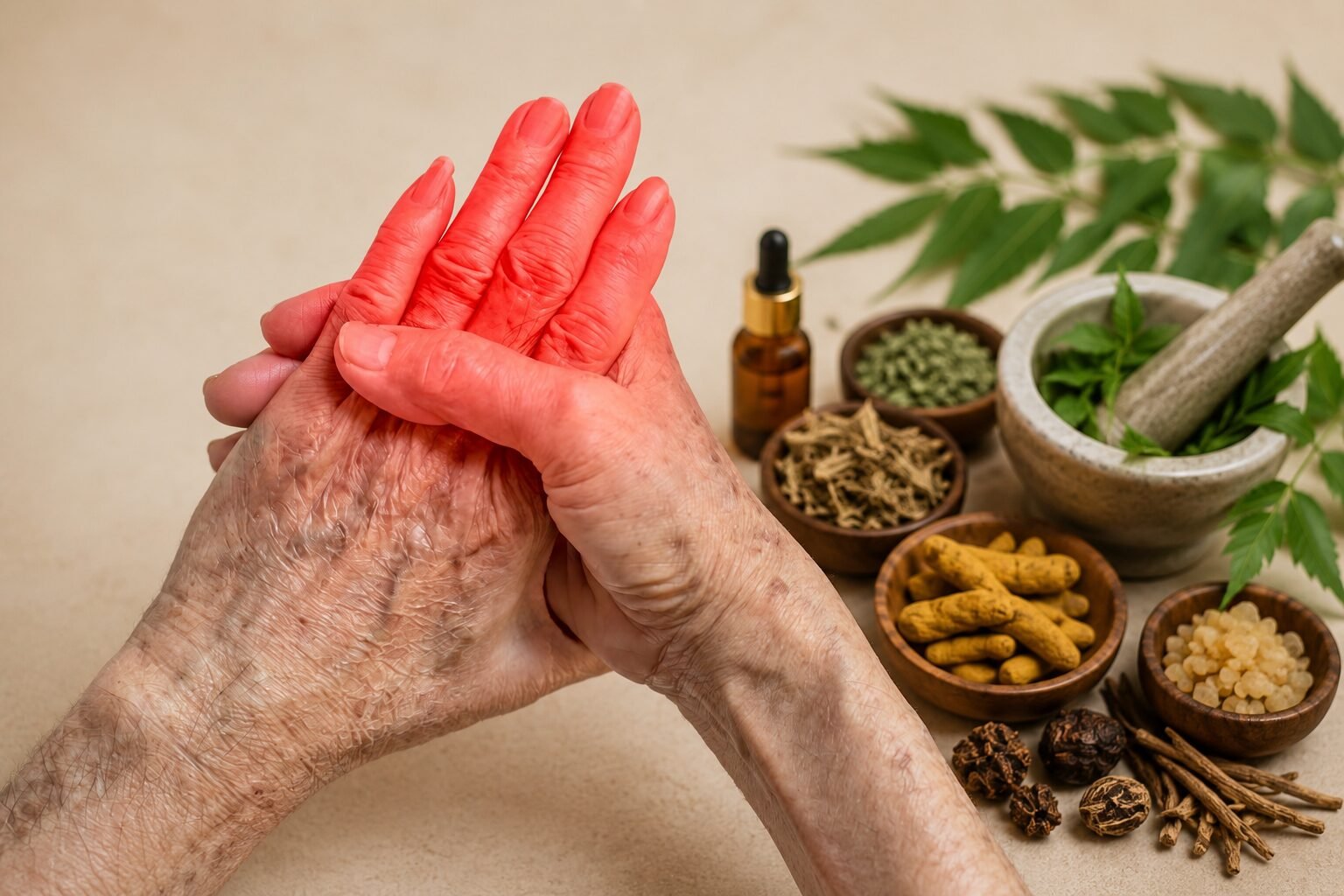
Rheumatoid Arthritis in Ayurveda is Amavata — a condition where Ama, the metabolic toxin produced by weak Agni, combines with vitiated Vata and lodges in the joints. The result is the inflammation, morning stiffness, symmetrical joint swelling, and progressive deformity that no DMARD fully resolves long-term. Basti Karma is the primary Ayurvedic intervention for Amavata because it works on both the Ama load and the Vata vitiation simultaneously, through the colon, which Ayurveda identifies as Vata’s primary seat.
According to I-AIM Healthcare Centre, Ayurveda Hospital in Bangalore, “Basti reaches where no oral medicine can. Administering medicated decoctions and oils directly into the colon clears Ama from deep tissue channels and corrects the Vata imbalance that is driving joint destruction in Amavata.”
Joints swollen and stiff every morning despite ongoing medication? Book Appointment
Why is Basti the primary treatment for Amavata, not just pain relief?
Most Rheumatoid Arthritis treatments suppress inflammation. Basti does something different — it removes the substrate causing it.
- Ama must be cleared from Srotas first: In Amavata, Ama blocks the micro-channels (Srotas) supplying joints. Anti-inflammatory drugs reduce the immune response to this blockage but leave the Ama in place. The joint damage continues underneath the suppression. Niruha Basti with Dashmoola decoction directly pulls this Ama out through the bowel
- Vata governs joint movement: Every aspect of joint function — lubrication, mobility, nerve signaling — is Vata-governed. Anuvasana Basti with medicated Ksheerabala or Mahanarayan oil nourishes the synovial tissue, restores lubrication, and corrects the dry, degenerative pattern Vata vitiation creates
- Oral medicines cannot match rectal absorption for Vata disorders: Ayurvedic texts describe Basti as half of all treatment because the colon absorbs medicated substances far more efficiently into systemic circulation for Vata-related conditions than the oral route
- Morning stiffness is a Kapha-Ama pattern: The characteristic morning stiffness of RA maps to overnight Ama and Kapha accumulation in joints. Consistent Basti administration breaks this accumulation cycle over the course rather than managing it symptom by symptom
Basti treatment at I-AIM is administered under physician supervision with formulations selected based on individual dosha assessment, not a standard Amavata template.
What does the full Kala Basti protocol for Amavata look like?
The classical protocol runs 19 days total — 3 days of internal preparation followed by a 16-day Kala Basti schedule.
- Days 1 to 3 — Deepana Pachana phase: Internal medicines to kindle Agni and begin digesting existing Ama before Basti starts. Chitrakadi Vati and Trikatu formulations typically used. Starting Basti without this phase can push undigested Ama deeper into tissues
- Days 4 to 19 — Kala Basti sequence: 16 sessions alternating in a fixed ratio — 11 Anuvasana (medicated oil) and 5 Niruha (medicated decoction) enemas. The alternating pattern matters. Niruha sessions clear Ama and excess Kapha. Anuvasana sessions nourish Vata, rebuild tissue, and prevent the dryness Niruha can cause if given alone
- Niruha formulation for Amavata: Dashmoola Kashaya as base with honey, rock salt, medicated ghee, and Rasna added. The decoction is body-temperature warm at administration. Each session retained for as long as physiologically possible before evacuation
- Anuvasana formulation: Ksheerabala Taila or Mahanarayan Taila for deep joint nourishment. Oil quantity calibrated to individual Bala (strength and digestive capacity)
- Parallel internal medicines: Maharasnadi Kwatha, Yogaraj Guggulu, and Shallaki formulations run alongside the Basti course to address systemic Ama and joint inflammation from the oral route simultaneously
Read about Ayurvedic treatment for psoriasis to understand how Panchakarma approaches other chronic inflammatory conditions with the same internal-first logic.
Why Choose I-AIM Healthcare Centre
I-AIM is NABH-accredited with a dedicated Panchakarma department and over 14 years of evidence-based Ayurvedic practice in Bangalore. Amavata cases here are assessed with Nadi Pariksha, inflammatory markers, and joint imaging before the Basti protocol is designed. The Niruha formulation and Anuvasana oil are selected per individual, not per condition alone.
A patient with seronegative RA on Methotrexate and Hydroxychloroquine for four years came in with persistent wrist and finger joint swelling, morning stiffness lasting three hours, and CRP consistently elevated. After the full 19-day inpatient Kala Basti course with Maharasnadi Kwatha, the 6-week follow-up showed CRP normalized, morning stiffness reduced to under 30 minutes, and grip strength measurably improved. The rheumatologist kept the medication unchanged. The Basti had done what the DMARD could not do alone.
Read more about I-AIM Healthcare Centre. Call 7204377000 to book your consultation.
Frequently Asked Questions
How many days does the Basti protocol for Rheumatoid Arthritis take?
The full Kala Basti protocol for Amavata runs 19 days — 3 days of Deepana Pachana preparation followed by 16 Basti sessions alternating Niruha and Anuvasana enemas in an 11:5 ratio.
Can Basti be done alongside existing RA medications?
Yes. Basti does not interact pharmacologically with DMARDs or biologics. Many patients complete the Basti course without any change to their prescription. Medication reduction, if appropriate, is discussed with the treating rheumatologist after the course based on clinical response.
What is the difference between Niruha and Anuvasana Basti?
Niruha Basti uses medicated herbal decoctions and is primarily eliminative — it clears Ama and excess doshas. Anuvasana Basti uses medicated oils and is primarily nourishing — it rebuilds Vata, lubricates joints, and repairs tissue. Both are needed in Amavata because the condition involves both accumulation and depletion simultaneously.
Is Basti safe for elderly Rheumatoid Arthritis patients?
Basti is generally well-tolerated in elderly patients. The physician adjusts the volume and concentration of both Niruha and Anuvasana formulations based on Bala assessment. Elderly patients with significant debility may receive a shorter Matra Basti sequence before progressing to the full Kala Basti protocol.
References
- Basti Karma in Amavata management — NCBI / PubMed
- WHO Traditional Medicine Strategy — World Health Organization