

Ayurveda for IBS: What Grahani Chikitsa Fixes?
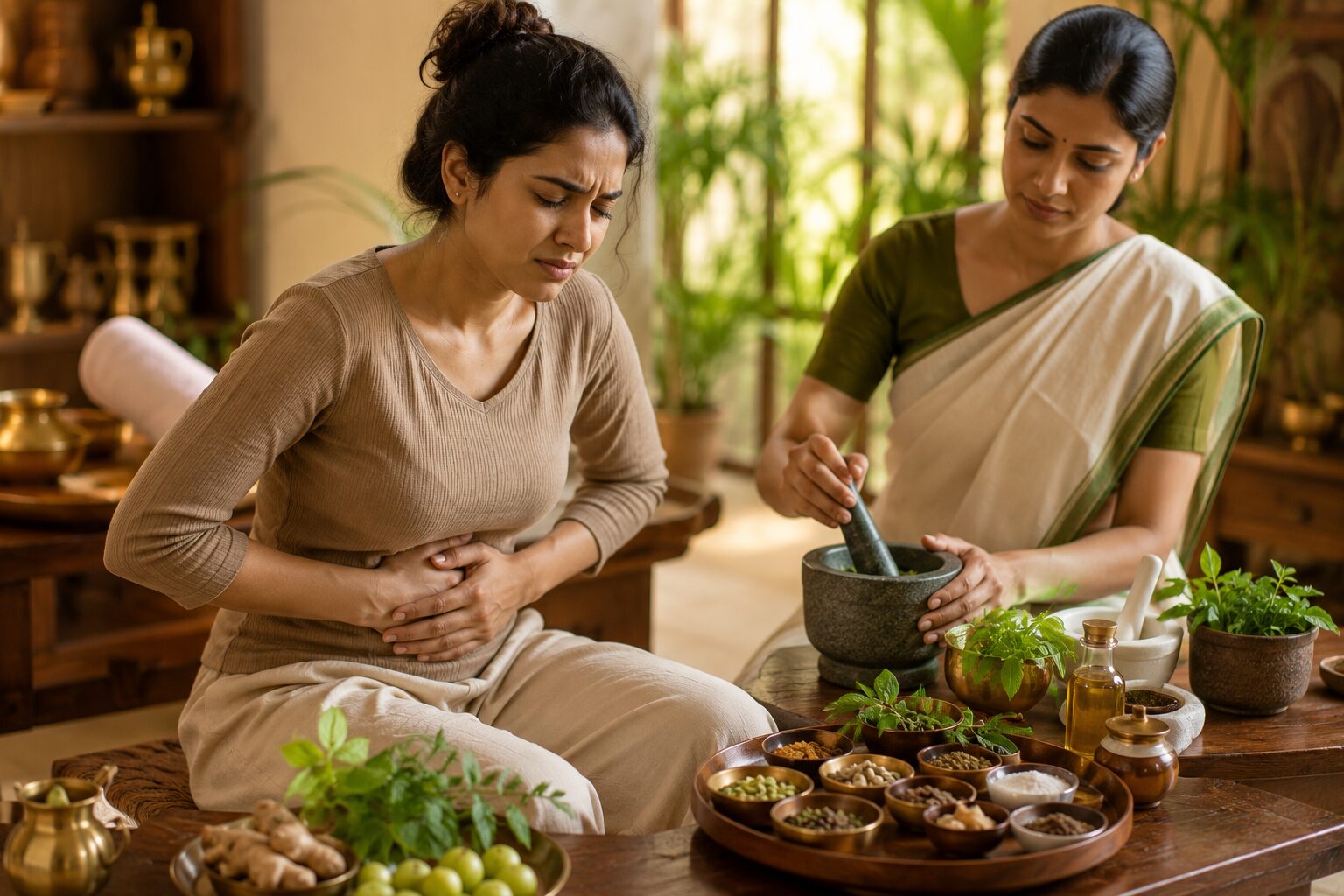
IBS is one of the most common reasons people end up with a normal colonoscopy and still feel unwell. Bloating, unpredictable bowel habits, and stress-linked flare-ups continue even after the scope comes back clear, because a colonoscopy checks for structural damage, not functional digestive weakness. Ayurveda calls this pattern Grahani Roga, a disorder rooted in weakened digestive fire (Agni), and treats it through a protocol called Grahani Chikitsa.
According to I-AIM Healthcare Centre, Ayurveda Hospital in Bangalore, “A colonoscopy rules out disease, but it can’t measure how well your Agni is functioning day to day. Grahani Chikitsa works on that functional weakness directly, that is the difference between ruling something out and actually treating what’s causing the symptoms.”
Bloating and irregular bowel habits despite a normal scope? Book Appointment
Why a Normal Colonoscopy Doesn’t Mean You’re Fine
A clear scope rules out structural disease, but it says nothing about how well your gut is actually functioning between meals.
- Colonoscopy checks structure, not function. It can rule out ulcers, tumors, or visible inflammation, but IBS is a functional disorder, meaning the tissue looks normal while the process of digestion itself is disturbed.
- Weak Agni goes undetected on any scan. Ayurveda holds that Grahani Roga starts with Mandagni, a weakened digestive fire, something no imaging test is designed to pick up.
- Ama keeps building quietly. When digestion is incomplete, undigested residue called Ama accumulates and irritates the gut lining, driving the bloating and irregularity many IBS patients live with long after a clear report.
- I-AIM evaluates function, not just structure. The gastroenterology and digestive health department assesses Agni strength and Vata-Pitta imbalance alongside standard diagnostic workups.
How Grahani Chikitsa Treats the Root Cause
Grahani Chikitsa isn’t one remedy. It’s a structured protocol that rebuilds digestive strength in stages rather than just controlling symptoms as they appear.
- Deepana-Pachana herbs restart digestion. Formulations with digestive and appetite-supporting properties, like Chitrakadi Churna, are used to correct Mandagni at its source.
- Vatanulomana eases erratic bowel movements. These properties help regulate Vata’s movement through the gut, addressing the alternating constipation and looseness many IBS patients experience.
- Targeted Shodhana clears deeper imbalance. In more stubborn cases, mild purification therapies are used to remove accumulated Ama rather than just managing it long term.
- Diet and routine hold the gains. A structured Ahara plan and consistent meal timing are prescribed alongside medicines, since irregular eating is considered a major trigger for relapse.
- Stress correction is built into the plan. Stress correction is built into the plan too. Ayurveda has never really separated mind from body, Manasika and Sharirika doshas are treated as connected, so patients whose flare-ups clearly track with stressful periods get calming therapies added in.
- A review in the Journal of Ayurveda and Integrated Medical Sciences backs this up, describing Grahani Roga as closely mirroring IBS, both in how it shows up and in the Agni-Vata disruption driving it. Case studies using Deepana-Pachana formulations have reported real relief for patients. That said, the researchers themselves say it’s early, larger trials still need to confirm how far this holds up. For more on how Ayurveda approaches digestive and metabolic health, read our earlier post on Virechana for fatty liver.
Why Choose I-AIM Healthcare Centre
I-AIM is a NABH-accredited hospital in North Bengaluru, and its gastroenterology team evaluates IBS and Grahani Roga through both a standard diagnostic workup and a detailed Agni-dosha assessment, so the treatment plan is built around the actual pattern driving each patient’s symptoms. Diet and lifestyle guidance are worked out together with the patient rather than handed over as a generic sheet, since sticking to it long term is what actually prevents relapse. This combination of proper diagnosis and practical follow-through is why many patients choose I-AIM after other approaches haven’t held. Call 7204377000 to book a consultation.
FAQs
Is Grahani Roga the same as IBS?
Close to it. Grahani Roga is the Ayurvedic term that lines up most closely with what modern medicine calls IBS.
Can I do this alongside my current gut medication?
Usually, yes. Your physician checks your current medications first to avoid any overlap.
How long before I notice anything?
Some patients feel a difference in 3 to 4 weeks. A full protocol tends to run 6 to 8 weeks for results that actually hold.
Does stress really make IBS worse?
It genuinely does. That’s part of why calming therapies are built into the plan for patients whose flare-ups line up with stressful periods.
References
- A Review Article of Grahani Roga and its Ayurvedic Management — Journal of Ayurveda and Integrated Medical Sciences
- A Clinical Study of Grahaninigraha Churna in the Management of Grahani Roga (IBS) — AYUHOM
Desclaimer:
This article is for informational purposes only and does not constitute medical advice. Please consult a qualified Ayurvedic physician before starting any treatment.