

What Pizhichil Does for Paralysis in Ayurveda?
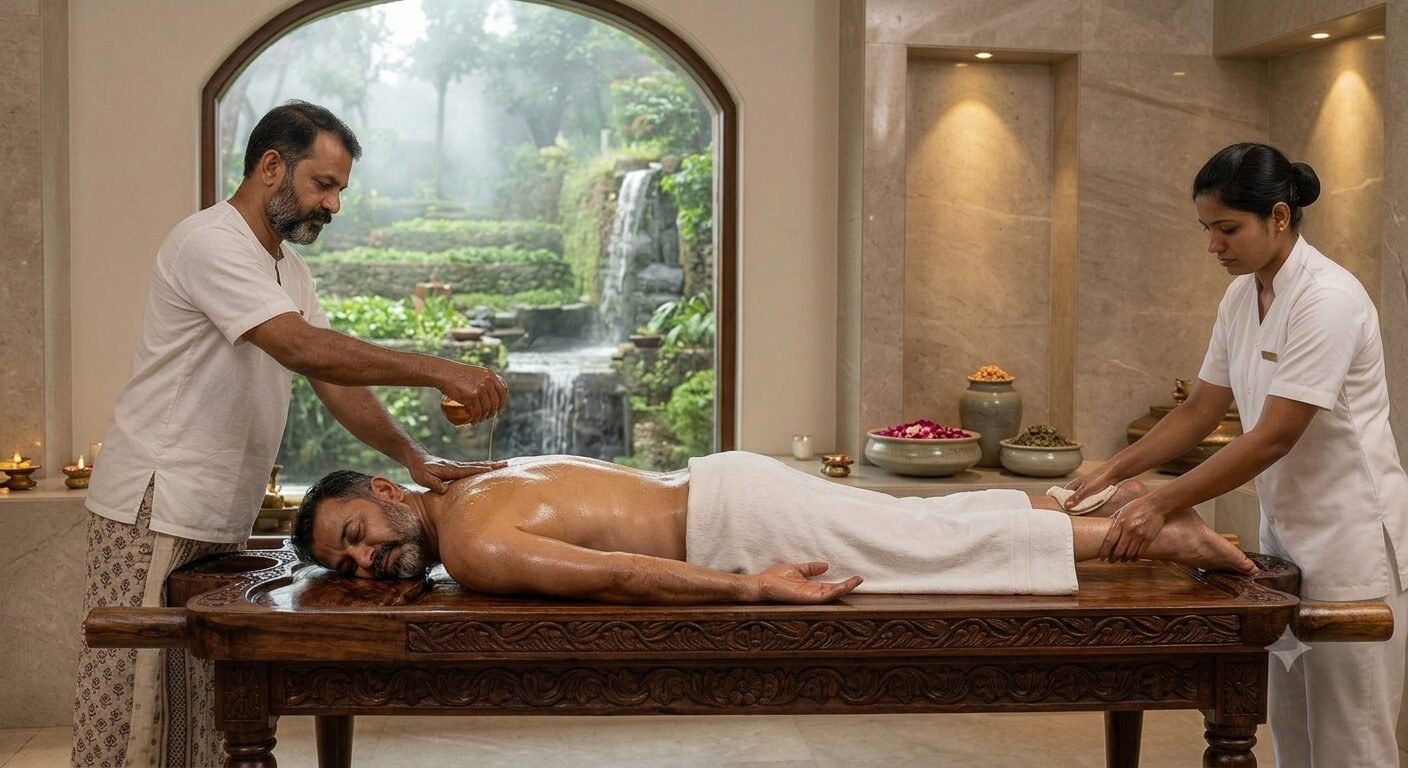
Pizhichil is one of Ayurveda’s most powerful therapies for paralysis. It works by calming aggravated Vata, improving blood flow to affected muscles, reducing stiffness, and feeding damaged nerve tissue with warm medicated oil. Four therapists pour oil continuously over the entire body while massaging in a coordinated rhythm so every muscle and nerve gets deep heat and nourishment at the same time. Physiotherapy teaches the body to move again. Pizhichil gives the nerves and muscles what they need to actually respond to that training.
According to I-AIM Healthcare Centre, Ayurveda Hospital in Bangalore, “Pizhichil does not compete with physiotherapy. It prepares the nervous system and muscles to respond to physiotherapy at a level no exercise alone can reach.”
Post-stroke or post-injury paralysis not improving with physiotherapy alone? Book Appointment
Why does paralysis rehabilitation plateau with conventional physiotherapy alone?
Physiotherapy retrains movement patterns. It cannot directly restore the damaged neurological tissue driving the deficit.
- Vata governs all nerve function: Every motor signal, sensory input, and muscle contraction is Vata-governed in Ayurveda. Paralysis Pakshavadha is the most severe manifestation of Vata vitiation, where the channels carrying motor impulses are obstructed or depleted. No amount of movement repetition restores Vata if the channel itself remains dry, obstructed, and undernourished
- Spasticity blocks motor recovery: Post-stroke and post-injury spasticity is a Vata-Pitta pattern where contracted, hypersensitive muscle fibres resist voluntary movement. Botulinum toxin reduces spasticity chemically for 3 to 4 months. It does not nourish the depleted Mamsa Dhatu and Majja Dhatu muscle and nerve tissue that the spasticity is simultaneously destroying
- Peripheral neuropathy compounds the deficit: In diabetic or post-traumatic nerve damage, the nerve sheath itself is depleted. Physiotherapy exercises a nerve that cannot conduct signals properly. Pizhichil’s deep oleation penetrates the nerve sheath, restores myelin-equivalent Majja tissue, and improves conduction before exercise can meaningfully rebuild strength
- The rehabilitation window closes without tissue nourishment: Neuroplasticity the brain’s ability to rewire motor pathways is time-sensitive and tissue-dependent. Patients who receive Pizhichil alongside physiotherapy in the first 6 to 18 months post-stroke show significantly better motor recovery than those who receive physiotherapy alone, because the underlying tissue has been nourished to respond
Neuromusculoskeletal care at I-AIM integrates Pizhichil with physiotherapy, yoga rehabilitation, and Ayurvedic internal medicines in a single coordinated protocol for paralysis and nerve damage cases.
How does Pizhichil actually work for paralysis and nerve damage?
The procedure runs 45 to 60 minutes daily for 14 to 28 days depending on severity. Every element of the protocol is clinically purposeful.
- Oil selection by condition: Ksheerabala Taila for post-stroke Pakshavadha and motor neuron involvement. Mahanarayan Taila for musculoskeletal paralysis with joint involvement. Dhanwantaram Taila for post-traumatic nerve damage and peripheral neuropathy. The wrong oil reduces outcomes significantly selection is based on Nadi Pariksha and neurological assessment, not condition alone
- Four-therapist synchronised pour: Two therapists on each side of the Droni table pour warm medicated oil in a continuous, coordinated stream while simultaneously performing rhythmic effleurage strokes. The synchronisation is not ceremonial it ensures uniform oil penetration across all muscle groups simultaneously, preventing uneven tissue saturation that single-therapist application cannot avoid
- Heat penetration mechanism: Oil at 38 to 42 degrees Celsius penetrates the skin barrier, enters subcutaneous tissue, and reaches the muscle and nerve layers within 20 to 30 minutes of sustained application. The sustained heat dilates peripheral blood vessels, increases oxygen delivery to ischaemic tissue around the nerve injury, and reduces inflammatory mediators that are blocking axonal regrowth
- Paschat Karma and physiotherapy sequencing: Pizhichil is immediately followed by a rest period and then physiotherapy on the same day. The muscle tissue is warm, supple, and neurologically primed from the oil treatment. Range of motion improves measurably in the post-Pizhichil physiotherapy session compared to sessions on non-treatment days
Read about Raktamokshana for gout to see how Ayurvedic para-surgical procedures address different tissue-level pathologies with the same precision-first approach.
Why Choose I-AIM Healthcare Centre?
I-AIM is NABH-accredited with a dedicated neuromusculoskeletal department and experienced Panchakarma physicians managing paralysis rehabilitation for over 14 years. Pizhichil protocols here are designed after neurological assessment, MRI review, and Nadi Pariksha not after a wellness consultation. A post-stroke patient with left hemiplegia, 8 months post-ictus, had plateaued at 40 percent motor recovery despite daily physiotherapy. After a 21-day inpatient Pizhichil course with Ksheerabala Taila combined with Basti and internal medicines, the physiotherapist documented 65 percent motor recovery at discharge. The patient walked with a single-point cane at the 3-month follow-up. He had been using a walker at admission.
Read more about I-AIM Healthcare Centre. Call 7204377000 to book your consultation.
FREQUENTLY ASKED QUESTIONS
How long does a Pizhichil course take for paralysis?
A standard course runs 14 to 28 days depending on severity and time since injury. Post-stroke patients within the first year respond best. Older cases take longer and have more modest outcomes.
Is Pizhichil safe for elderly patients?
Yes. Oil volume and temperature are adjusted based on the patient’s strength. The procedure is passive the patient simply lies still so it is well tolerated even in elderly and frail patients.
Can Pizhichil help diabetic neuropathy?
Yes. Diabetic neuropathy depletes the nerve sheath tissue Ayurveda calls Majja Dhatu. Pizhichil with Dhanwantaram Taila nourishes this tissue and reduces burning, numbness, and tingling. Blood sugar should be reasonably controlled before starting.
Does it work for spinal cord injuries?
Incomplete spinal cord injuries where some movement or sensation remains respond well. Complete injuries may see reduced spasticity and improved muscle tone but full motor recovery is not a realistic expectation.
References
- Pizhichil in neurological rehabilitation — PMC / NCBI
- Ayurvedic management of Pakshavadha (hemiplegia) — NCBI / PubMed
Disclaimer
This article is for informational purposes only and does not constitute medical advice. Please consult a qualified Ayurvedic physician before beginning any treatment.