

How Bloodletting Clears Uric Acid in Ayurveda?
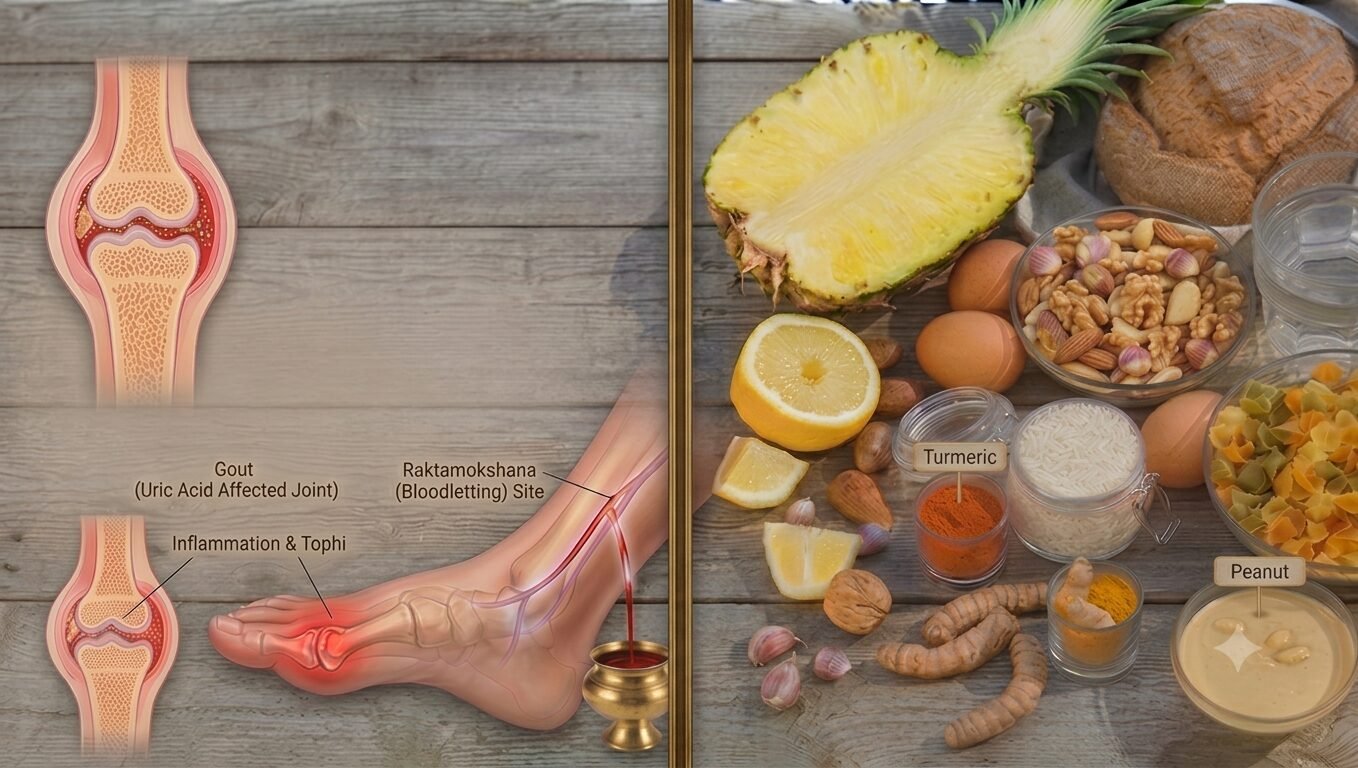
In Ayurveda, bloodletting clears uric acid by directly removing stagnant, toxin-laden blood from affected joints while simultaneously balancing deeply aggravated Vata and Pitta doshas. Known classically as Raktamokshana, this Panchakarma therapy targets the root pathology of Vatarakta the ancient Ayurvedic classification for gout and hyperuricemia. Uric acid crystals depositing in joints are not the disease in Ayurveda. They are the visible result of Rakta Dushti vitiated blood carrying Ama that the body can no longer process or clear. Allopurinol lowers serum uric acid. It does not remove the vitiated Rakta already lodged in the joint. Raktamokshana does.
According to I-AIM Healthcare Centre, Ayurveda Hospital in Bangalore, “Gout patients who only manage uric acid levels with medication still experience flares because the vitiated blood in the joint was never cleared. Raktamokshana removes what caused the crystal deposition, not just the crystals themselves.”
Recurring gout flares despite uric acid medication? Book Appointment
Why does gout keep recurring despite uric acid-lowering treatment?
Conventional gout management targets serum uric acid numbers. Ayurveda targets the vitiated tissue producing them.
- Rakta Dushti persists after medication: Allopurinol and Febuxostat reduce uric acid production or excretion. They do not purify the Rakta Dhatu, the blood tissue that has been vitiated by years of Pitta aggravation and Ama accumulation. The metabolic environment that crystallised uric acid in the first place remains unchanged
- Vata drives the pain independently: In Vatarakta, vitiated Vata obstructs the channels supplying the joints while Pitta-aggravated blood accumulates in the same space. The inflammation, swelling, and burning pain are a Vata-Pitta combination disorder. NSAIDs and colchicine suppress the inflammatory response but leave both doshas intact
- Ama keeps feeding the cycle: Weak Agni produces Ama with every meal. Ama mixes with Rakta and travels to peripheral joints the big toe, ankle, and knee preferentially because Vata naturally moves downward. No uric acid test measures Ama. No allopathic drug clears it
- Leech therapy clears what purging cannot: Pitta-dominant blood disorders with joint involvement need local Rakta clearance, not systemic purging. Virechana helps. But Jalauka — leech therapy, a form of Raktamokshana — draws vitiated blood directly from the affected joint with a precision that no systemic intervention can match
Raktamokshana treatment at I-AIM is performed by Dr. Vikram Balu, a specialist in para-surgical Ayurvedic procedures with over 10 years of clinical experience in Siravyadha and Jalauka procedures.
How does Raktamokshana actually work for gout?
The procedure selection depends on the stage of Vatarakta and which dosha is dominant.
- Jalauka (leech therapy) for acute Pitta-dominant gout: Medicinal leeches applied directly over the inflamed joint. The leech secretes hirudin and other anti-inflammatory compounds into the tissue while drawing vitiated blood out. The joint visibly decompresses within 20 to 30 minutes. Redness, heat, and swelling reduce significantly in the same session. Used for hot, red, burning gout flares where Pitta dominates
- Siravyadha (venesection) for chronic Vata-Pitta gout: A fine needle punctures a superficial vein near the affected joint to release a controlled quantity of vitiated blood. Used for chronic, recurring gout with joint deformity risk where both doshas are significantly involved. Requires physician assessment of Bala before each session
- Internal medicines alongside Raktamokshana: Guduchi Sattva, Kaishore Guggulu, Triphala Churna, and Manjisthadi Kashaya prescribed throughout. These purify Rakta Dhatu systemically, reduce Pitta aggravation, and correct the Agni dysfunction producing Ama. Dietary restrictions on red meat, alcohol, and fermented foods are mandatory
- Virechana before Raktamokshana in severe cases: Where Pitta load is very high, a Virechana course clears systemic Pitta first before local Raktamokshana begins. Attempting joint-level bloodletting without first reducing systemic Pitta gives incomplete and short-lived results
Read about Varsha Ritucharya and monsoon Basti — monsoon is when Vatarakta flares most predictably and preventive Panchakarma during this season significantly reduces gout frequency.
Why Choose I-AIM Healthcare Centre
I-AIM is NABH-accredited with a dedicated para-surgical Panchakarma department performing Jalauka and Siravyadha under physician supervision. Gout cases are assessed with serum uric acid, Nadi Pariksha, and joint examination before any procedure is performed. A patient with tophi formation on both feet and three hospitalisations for acute gout in 18 months came in on maximum dose Allopurinol with persistent joint swelling. After three Jalauka sessions over 10 days combined with Kaishore Guggulu and dietary correction, the acute swelling resolved completely. At the 6-month follow-up, serum uric acid had normalised and no further hospitalisation had occurred. The Allopurinol dose was halved under the physician’s supervision.
Read more about I-AIM Healthcare Centre. Call 7204377000 to book your consultation.
Frequently Asked Questions
Is leech therapy painful for gout patients?
Leech bites cause minimal discomfort and a brief pinching sensation at application. The leech’s saliva contains natural anaesthetic compounds that reduce pain rapidly. Most patients describe the session as significantly less uncomfortable than the gout flare itself.
How many Raktamokshana sessions are needed for gout?
Acute presentations typically require 2 to 3 Jalauka sessions over 7 to 10 days. Chronic recurrent gout with joint involvement may need 4 to 6 sessions spread across 3 to 4 weeks alongside internal medicines and dietary correction.
Can Raktamokshana be done during an active gout flare?
Yes, acute Pitta-dominant flares with heat, redness, and swelling are the primary indications for Jalauka. The procedure is most effective during the active flare when vitiated blood is most accessible at the joint surface. The physician assesses contraindications before proceeding.
Does Ayurvedic gout treatment work alongside Allopurinol?
Yes. Raktamokshana and Ayurvedic internal medicines do not interact with Allopurinol or Febuxostat. Many patients continue their uric acid medication through the Ayurvedic course. Dose adjustments are made only after documented serum uric acid normalisation under physician supervision.
Disclaimer
This article is for informational purposes only and does not constitute medical advice. Please consult a qualified Ayurvedic physician before beginning any treatment.