

Ayurvedic Treatment for Frozen Shoulder?

Frozen shoulders has a frustrating way of lingering for months, sometimes over a year, even with physiotherapy and painkillers. Ayurveda calls this condition Avabahuka, and sees it as a localized flare-up of aggravated Vata dosha right in the shoulder joint. Ayurveda for frozen shoulders focuses on calming that Vata disturbance directly, through a combination of Panchakarma and supporting external therapies, rather than just managing the pain while mobility stays limited.
According to I-AIM Healthcare Centre, Ayurveda Hospital in Bangalore, “Painkillers and stretching exercises help manage the stiffness, but they don’t correct the Vata vitiation sitting in the shoulder joint causing it. Ayurvedic treatment for frozen shoulder works on that joint directly through oil therapies and heat treatment, that is the difference between managing stiffness and actually restoring the joint’s range of motion.”
Shoulder stiffness lingering for months despite physiotherapy? Book Appointment
Why Frozen Shoulder Takes So Long to Resolve?
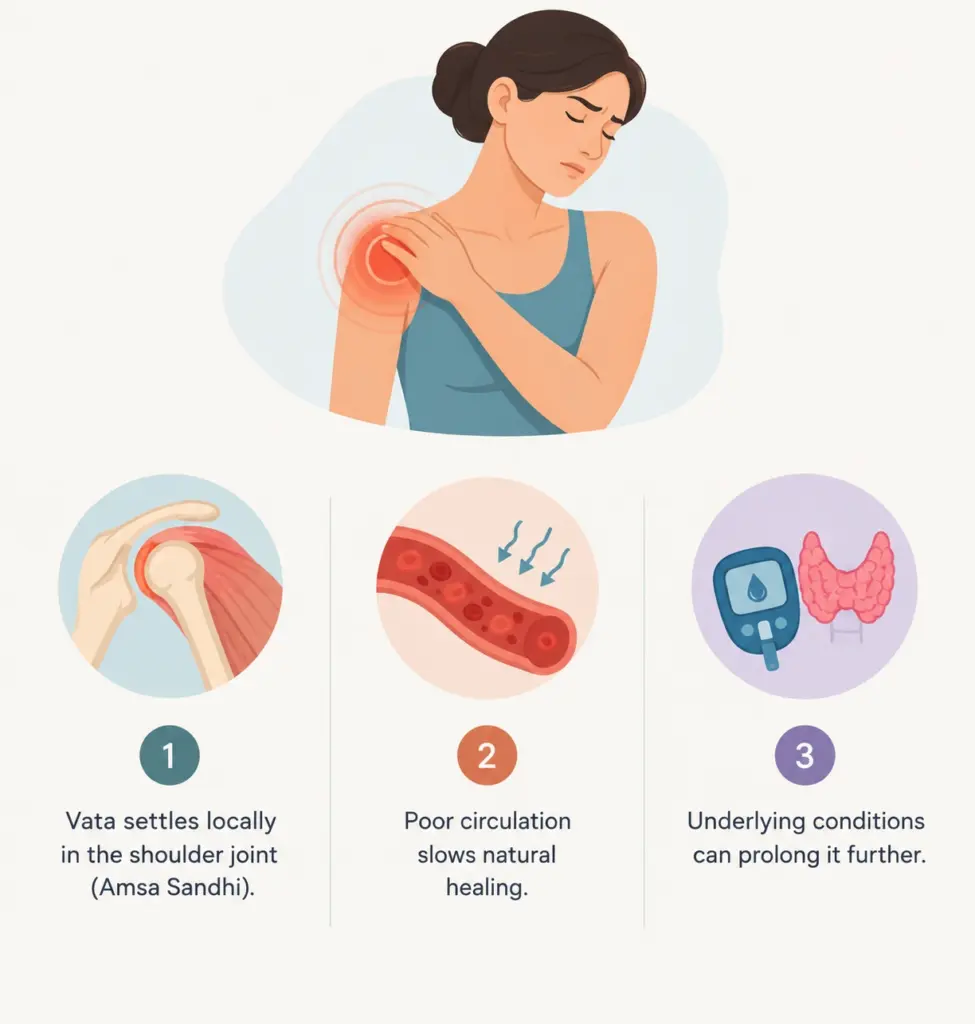
Frozen shoulder is known for moving through stages, freezing, frozen, and thawing, and conventional treatment often means waiting it out alongside physiotherapy.
- Vata settles locally in the shoulder joint (Amsa Sandhi). Ayurveda considers this joint particularly vulnerable to Vata vitiation, which is believed to directly cause the capsule stiffening seen in frozen shoulder.
- Poor circulation slows natural healing. Aggravated Vata is thought to restrict blood flow to the joint capsule, which may be part of why recovery drags on without targeted treatment.
- Underlying conditions can prolong it further. Diabetes and thyroid imbalance are both recognized risk factors for frozen shoulder, adding another layer that generic stretching alone doesn’t address.
I-AIM’s musculoskeletal and nerve disorders team evaluates Avabahuka with a Vata-focused joint assessment alongside standard orthopedic evaluation, rather than treating every case with the same generic exercise sheet.
How Panchakarma Actually Treats Avabahuka?

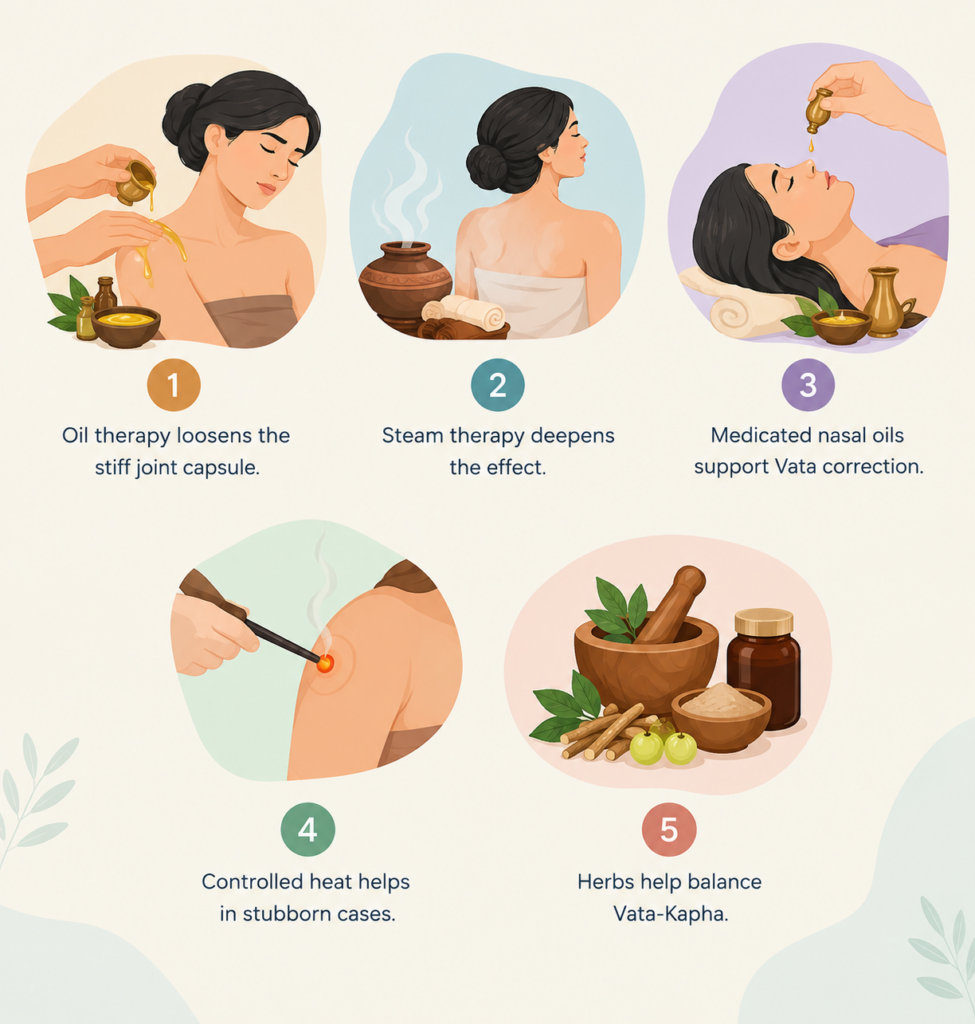
Treatment usually combines a few therapies, each targeting the shoulder from a slightly different angle.
- Snehana loosens the stiff joint capsule. Oil therapies like Balataila are applied locally to nourish and soften the restricted tissue.
- Swedana follows to deepen the effect. Steam or heat-based sudation therapy is used right after oleation to open up the area further.
- Nasya supports Vata correction through the head. Medicated nasal oils are considered especially useful for shoulder conditions, since the upper body channels are thought to respond well to this route.
- Agnikarma is used in more stubborn cases. This controlled heat application has shown notable results in several published case reports for patients with persistent stiffness.
- Internal herbs round out the protocol. Formulations such as Ashwagandha and Panchatikta Ghrita Guggulu are commonly prescribed to support Vata-Kapha balance alongside the external therapies.
A review published in the Asian Pacific Journal of Health Sciences analyzed 85 published clinical studies on Avabahuka management and found Panchakarma-based approaches consistently effective in reducing pain and stiffness while restoring shoulder mobility, though the authors also noted a need for more rigorous, evidence-based research going forward. A separate published case study using a combined Panchakarma regimen reported significant improvement on both the VAS pain scale and SPADI functional score over the treatment course. For more on how Ayurveda treats another Kapha-Vata condition, our earlier post on Ayurveda for PCOS covers a similar dosha-based approach.
Why Choose I-AIM Healthcare Centre?
North Bengaluru’s I-AIM is NABH-accredited, and honestly, what sets their musculoskeletal team apart with Avabahuka cases is how little they stick to a script. Snehana, Swedana, Nasya, sure, those show up in most plans, but the order and emphasis shift based on where the shoulder actually is, early stiffness versus a joint that’s been frozen for eight months calls for different handling. They’ll also pull up your thyroid or blood sugar numbers before locking anything in, since both tend to quietly mess with how fast a shoulder heals. About Us has more on the hospital if you want it. Otherwise, 7204377000 gets you a consultation booked.
FAQs
How long does this whole thing usually take?
Figure 2 to 4 weeks for the initial round. Whether you’re fully back to normal range sooner or later than that really comes down to how long you’d been stuck before starting.
Does Agnikarma hurt?
Less than the name suggests. It’s quick, it’s controlled, a trained hand does it, and most people say it’s uncomfortable at worst, not painful.
Am I allowed to keep doing physio alongside this?
Yes, actually they’ll probably tell you to. The two approaches end up working together pretty well rather than getting in each other’s way.
Once it’s fixed, does frozen shoulder come back?
Rarely in the same shoulder, assuming you actually got your full range of motion back. Keeping up with some exercise afterward is really what locks that in.
References
- Ayurvedic Management of Avabahuka (Frozen Shoulder): A Review of Clinical Studies — Asian Pacific Journal of Health Sciences
- Management of Avabahuka (Frozen Shoulder) with Ayurveda Therapeutic Regimen: A Case Study
Desclaimer:This article is for informational purposes only and does not constitute medical advice. Please consult a qualified Ayurvedic physician before starting any treatment.